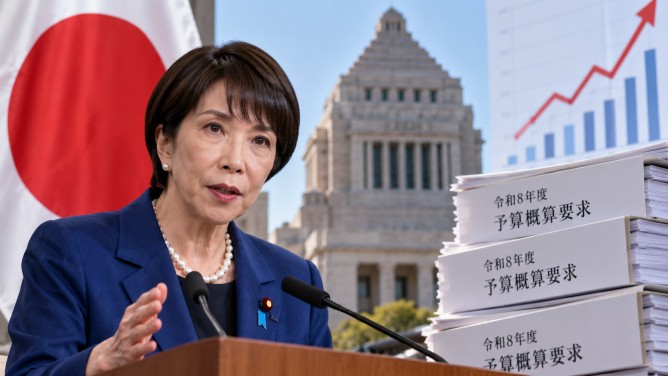
Japan’s government agencies have put forward budget requests amounting to 143.1 trillion yen ($917.8 billion) for the upcoming fiscal year, nearing the high expenditure levels witnessed during the COVID-19 pandemic. This substantial budget proposal aligns with Prime Minister Sanae Takaichi’s expansionary fiscal strategy, which prioritizes investments in strategic sectors such as artificial intelligence, semiconductors, and economic security. Within this framework, requests under a newly introduced strategic investment initiative have alone reached 12.2 trillion yen.
The potential for increased defense spending is notable as the government revisits its defense strategy, with several budget items still awaiting specific financial allocations. This financial planning comes at a time when rising borrowing costs are exerting additional pressure on Japan’s fiscal situation. The Finance Ministry has adjusted its projected interest rate to 3.8% from 3.0%, following an increase in the 10-year government bond yield to 3%, marking its highest point since 1996.
Consequently, requests for debt-servicing expenses, which encompass interest payments and debt redemption, have soared to a record 36.64 trillion yen, reflecting an increase of 5.36 trillion yen compared to the current fiscal year. This situation places the government under scrutiny as it prepares to finalize the fiscal 2027 budget, particularly regarding the issuance of new government bonds. Prime Minister Takaichi has expressed the government’s intention to limit new bond issuance to around 40 trillion yen while striving to lower the debt-to-GDP ratio.
The challenge now lies in striking a balance between enhancing investment in growth-oriented sectors and maintaining fiscal discipline, as the cost of servicing Japan’s substantial public debt rises in tandem with increasing interest rates. This delicate balancing act will be crucial for the government to sustain economic growth while managing its financial obligations prudently.