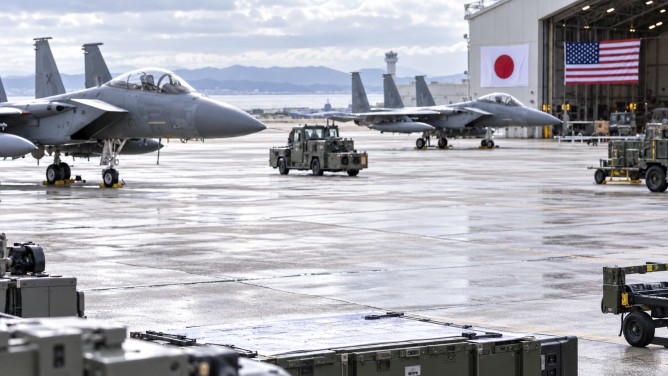
Japan and the United States have commenced large-scale joint military exercises, Keen Sword 27, aimed at bolstering defense capabilities on Japan’s southwestern islands amid rising regional tensions. The biennial drills involve approximately 45,000 Japanese and 12,000 U.S. military personnel and will run through October 29.
The exercises focus on enhancing coordination between the two nations’ armed forces and include participants from seven other countries, such as France, Germany, the Netherlands, New Zealand, and the Philippines, which are joining for the first time. Key activities involve amphibious landings, air and missile defense, mine-clearing operations, intelligence gathering, logistics, resupply, and casualty evacuation, taking place across several remote islands, including Tanegashima, Yonaguni, and Ishigaki.
Yonaguni, being Japan’s westernmost island, holds strategic significance due to its proximity to Taiwan, located about 110 kilometers to the east. During the exercise, Japan has deployed its Type-25 land-to-ship missile system to Yonaguni for the first time, although no test-firing is planned. The U.S. military is contributing systems like the NMESIS anti-ship missile system and the MADIS short-range air defense system on Yonaguni, along with the HIMARS mobile rocket launcher on Ishigaki. Live-fire exercises are scheduled at a Pacific Ocean training site.
Japanese officials have clarified that the exercises are not directed against any specific nation but emphasize the importance of military preparedness and collaboration with allies for national defense and regional stability. The drills occur amid strained relations between Japan and China, largely due to disagreements over Taiwan and China’s expanding military activities in the region. Japan has been fortifying its southwestern island defenses, deploying longer-range missiles and interception systems in recent years.
These joint military activities underline the growing significance of defense cooperation between Japan and the United States as both countries aim to enhance readiness and address evolving security challenges in the Indo-Pacific. Concurrently, there is ongoing public debate in Japan regarding the presence of U.S. military bases, particularly on Okinawa, where residents have expressed concerns about noise, pollution, and criminal incidents linked to the bases.